
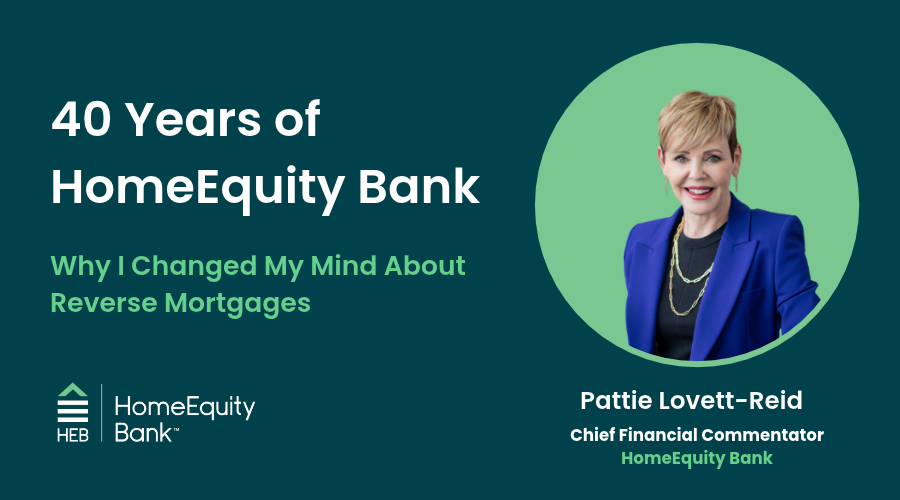
By Pattie Lovett-Reid
A reverse mortgage was once a product I questioned quickly. I wasn’t alone. For years, it seemed to sit in its own category on Bay Street: a financial idea many people were more comfortable dismissing than discussing.
So, as HomeEquity Bank marks 40 years, I want to offer more than congratulations. I want to tell the truth about my own change of heart.
I had questions. I still do. A reverse mortgage is a loan secured against a home. It comes with costs, and it won’t suit everyone. People deserve to understand exactly what they are considering, what it may cost over time, and what other options they have. A home is often the largest asset a family owns. It should never be treated casually.
But I came to see that I had been too quick to put the product in a box before fully considering the people it might help.
The shift wasn’t a dramatic lightbulb moment. It was a gradual change in how I thought about retirement planning. We talk about savings, pensions and investments. We talk about whether the numbers will last. But for many Canadians, there’s another major asset in the picture: the home they’ve spent a lifetime paying for and caring for. Leaving that equity out of the conversation can mean leaving out a choice.
That doesn’t make a reverse mortgage the answer. It makes home equity a subject worth discussing.
For some people, accessing a portion of their home’s value could create more room in a retirement budget, help manage debt, pay for a renovation, or support a family member. For others, borrowing against their home won’t fit their priorities, their finances or the legacy they want to leave. Both are reasonable. The point is to understand the choices before assuming there are none.
That’s the question I now find myself asking: not “Is this product good or bad?” but “Could it be right for this person, at this time, for this reason, and have they had a clear-eyed look at the costs and alternatives?”
That is how I think about any financial product. No product is right simply because it exists, and we shouldn’t reject a product before we understand what it does. The job is to ask good questions, look at the full picture and help people make decisions that fit their lives.
HomeEquity Bank began in 1986 with an idea many Canadians were not yet ready to embrace. Forty years later, the conversation has changed. I’ve changed, too. I’ve come to
appreciate that home equity can be one part of a thoughtful retirement plan, when it suits the person and the circumstances.
Congratulations to everyone at HomeEquity Bank on this milestone, and on helping move the conversation from reflexive skepticism to informed consideration. That’s a meaningful achievement. And for me, it’s a reminder that sometimes the most useful thing a financial commentator can do is be willing to reconsider.
The right product, for the right person, at the right time. That’s where the conversation should begin.
Pattie Lovett-Reid is Chief Financial Commentator at HomeEquity Bank